
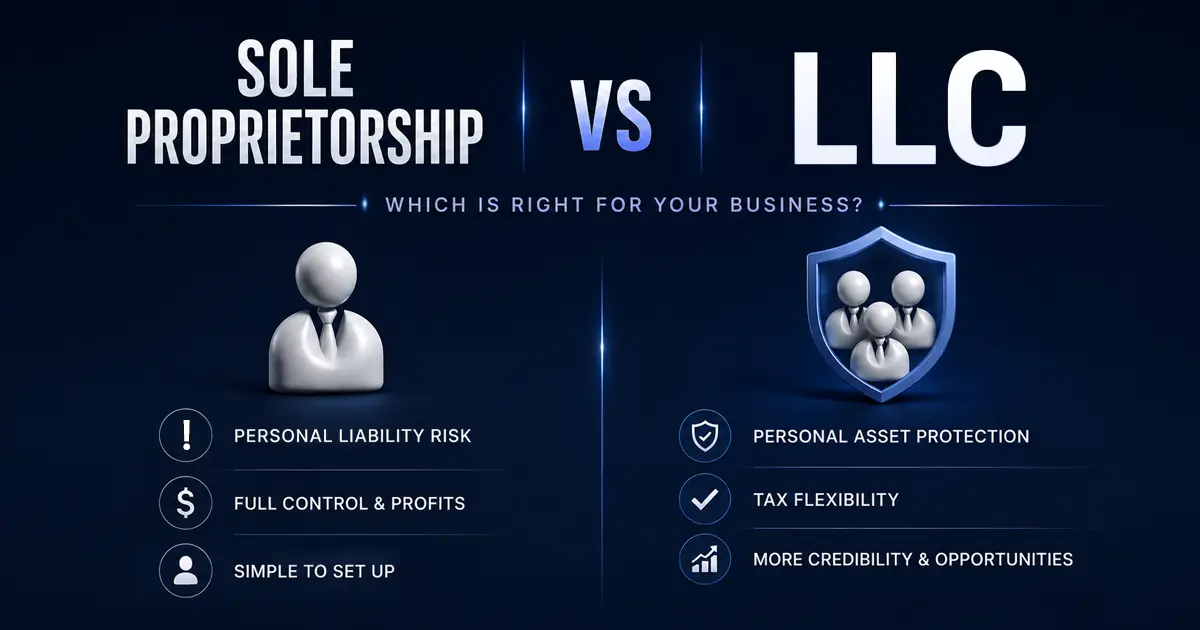
Choosing a business structure is one of the first important decisions for a new entrepreneur in the United States.
Two common options are a sole proprietorship and a limited liability company (LLC). Both can work for small businesses, but they differ in areas such as liability protection, formation requirements, taxes, paperwork, and ongoing compliance.
If you're deciding between an LLC vs. sole proprietorship, understanding these differences can help you have a more informed conversation with a business attorney, accountant, or tax professional.
What Is a Sole Proprietorship?
A sole proprietorship is a business owned and operated by one person.
It is generally one of the simplest business structures to establish because the business and owner are not separate legal entities for liability purposes.
A person may operate a business as a sole proprietor without creating an LLC or corporation, although local licenses, permits, registrations, and tax requirements may still apply.
Examples
A sole proprietor might operate:
* Freelance writing
* Graphic design
* Consulting
* Photography
* Home services
* Tutoring
* Online services
* Small retail activities
The owner generally reports business income and expenses on their individual tax return according to applicable federal and state rules.
What Is an LLC?
An LLC, or Limited Liability Company, is a business entity created under state law.
An LLC can generally provide a legal separation between the business and its owners, although the exact protection depends on the circumstances and applicable law.
An LLC may have:
* One owner
* Multiple owners
* Different management arrangements
The owners are generally called members.
An LLC is popular among small-business owners because it can combine liability protection with relatively flexible management and tax treatment.
LLC vs. Sole Proprietorship: Key Differences
Here's a simple comparison:
| Feature | Sole Proprietorship | LLC |
| --------------------- | --------------------------------------- | ------------------------------------------------- |
| Separate legal entity | Generally no | Yes |
| Liability protection | Limited | Generally provides liability protection |
| Formation | Usually simpler | Requires state formation |
| State filing | May not require entity formation filing | Usually required |
| Ongoing compliance | Often simpler | State requirements may apply |
| Tax treatment | Generally reported by owner | Can vary depending on elections and circumstances |
| Business name | May require DBA registration | Entity name registered with state |
| Multiple owners | No | Yes |
| Business separation | Limited | Generally stronger |
| Cost | Usually lower | Usually higher |
The exact rules depend on the state where the business operates.
Liability Protection
One of the biggest differences between an LLC and a sole proprietorship is liability protection.
Sole Proprietorship
Because the business and owner are generally not legally separate, the owner's personal assets may be exposed to certain business liabilities.
For example, if a business faces a lawsuit or unpaid obligation, personal assets may potentially be at risk, depending on the circumstances and applicable law.
LLC
An LLC generally provides a legal separation between the business and its members.
This can help protect personal assets from certain business liabilities.
However, an LLC is not an absolute shield.
Personal liability can still arise in situations such as:
* Personal guarantees
* Fraud
* Certain wrongful acts
* Failure to maintain appropriate separation
* Certain tax obligations
* Other circumstances recognized under applicable law
This is why business owners should understand both entity protection and insurance.
How Are Sole Proprietorships Taxed?
A sole proprietor generally reports business income and deductible business expenses on their individual federal tax return.
Business profit generally becomes part of the owner's taxable income.
Depending on the circumstances, self-employment taxes may also apply.
State and local tax rules can differ.
Because tax treatment depends on individual circumstances, it's useful to consult a tax professional when making a business-structure decision.
How Are LLCs Taxed?
An LLC can have different tax classifications.
A single-member LLC is generally treated as a disregarded entity for federal income-tax purposes unless the owner makes an election to be taxed differently.
A multi-member LLC is generally treated as a partnership by default for federal income-tax purposes unless it makes another election.
An LLC may also be eligible to elect corporate tax treatment if it meets applicable requirements.
This flexibility is one reason LLCs are commonly used by small-business owners.
LLC vs. Sole Proprietorship: Startup Cost
A sole proprietorship can be relatively inexpensive to start because there is generally no state entity-formation filing required simply to become a sole proprietor.
However, you may still need:
* Business licenses
* Local permits
* DBA registration
* Professional licenses
* Insurance
* Tax registrations
An LLC usually requires a state filing fee to form the entity.
Fees vary significantly by state.
Some states also impose ongoing annual or periodic fees, reports, franchise taxes, or other requirements.
Always check the rules in the state where your LLC is formed or operates.
Which Is Easier to Start?
A sole proprietorship is generally simpler.
You can often begin operating once you have handled the licenses, permits, registrations, and tax requirements applicable to your business.
An LLC involves additional steps because you generally need to:
1. Choose an available business name.
2. Select a registered agent where required.
3. File formation documents with the state.
4. Pay the applicable state fee.
5. Create an operating agreement where appropriate.
6. Obtain an EIN when required or useful.
7. Open a business bank account.
8. Maintain required state filings.
The exact requirements depend on the state.
What Is an EIN?
An Employer Identification Number (EIN) is a federal tax identification number issued by the IRS.
Businesses may need an EIN for various purposes, including certain employment and tax situations.
Even when a sole proprietor doesn't strictly need an EIN for federal tax purposes, obtaining one can sometimes be useful for separating business activities from personal information and for banking or business administration.
LLCs may also need an EIN depending on their tax structure and circumstances.
Do You Need a Business Bank Account?
Keeping business finances separate from personal finances is an important practice for many business owners.
A dedicated business bank account can help you:
* Track revenue
* Track expenses
* Simplify bookkeeping
* Prepare tax records
* Manage payroll
* Maintain financial separation
For an LLC, keeping business and personal finances separate is particularly important for maintaining the company's distinct business identity.
LLC vs. Sole Proprietorship for Freelancers
Freelancers often start as sole proprietors because the structure can be simple.
For example, a freelancer might provide:
* Web development
* SEO
* Copywriting
* Graphic design
* Consulting
* Video editing
* Marketing services
As the business grows, the owner may consider forming an LLC for liability protection, credibility, operational reasons, or other business considerations.
There isn't a universal point at which every freelancer should switch to an LLC.
LLC vs. Sole Proprietorship for Online Businesses
Online businesses can use either structure depending on their circumstances.
Examples include:
* E-commerce
* Affiliate marketing
* Digital products
* Online consulting
* Software services
* Content creation
* Online education
* Digital marketing
Even though an online business may operate from home, it can still face contracts, customer disputes, intellectual-property issues, payment disputes, and other business risks.
The appropriate structure should be considered alongside contracts and insurance.
Does an LLC Pay Less Tax Than a Sole Proprietorship?
Not automatically.
An LLC is a legal business structure, while tax treatment is a separate issue.
A single-member LLC may receive the same default federal income-tax treatment as a sole proprietorship.
However, an LLC may have options to elect different federal tax treatment if eligibility requirements are met.
Therefore, forming an LLC does not automatically mean you'll pay less tax.
A tax professional can help determine whether a different tax election makes sense for your situation.
Can a Sole Proprietor Have Employees?
Yes.
A sole proprietor can generally hire employees, although doing so creates additional responsibilities.
These can include:
* Payroll
* Employment taxes
* Worker classification
* Employment records
* Required insurance
* Federal and state registrations
* Labor-law compliance
If you're hiring workers, make sure you understand applicable federal, state, and local requirements.
Can an LLC Have Employees?
Yes.
An LLC can also hire employees.
The company may need to:
* Obtain required registrations
* Handle payroll
* Withhold applicable taxes
* Pay employer taxes
* Maintain employee records
* Follow applicable employment laws
* Carry required insurance
The exact requirements depend on the business and location.
LLC vs. Sole Proprietorship: Privacy
Neither structure automatically guarantees complete privacy.
Business information can be available through:
* State business records
* Licenses
* Public filings
* Business websites
* Property records
* Other public databases
Privacy rules vary by state.
If privacy is an important consideration, review your state's filing requirements before choosing a structure.
LLC vs. Sole Proprietorship: Credibility
Some customers may perceive an LLC as more established than a sole proprietorship.
For example, a company name such as:
ABC Marketing LLC
may appear more formal than operating under an individual's personal name.
However, customers generally care about factors such as:
* Quality
* Reliability
* Reviews
* Experience
* Communication
* Pricing
* Results
Business structure alone doesn't determine credibility.
When Might a Sole Proprietorship Make Sense?
A sole proprietorship may be worth considering when:
* You're testing a new business idea.
* You're operating a very small business.
* Business risk is relatively limited.
* You want minimal administrative complexity.
* You're starting with a limited budget.
* You have no co-owners.
Even then, appropriate insurance and contracts may still be important.
When Might an LLC Make Sense?
An LLC may be worth considering when:
* You want a formal business entity.
* Your business has meaningful liability exposure.
* You want legal separation between business and personal assets.
* You have business partners.
* You're entering contracts regularly.
* You're building a business intended to grow.
* You want flexibility in tax classification.
The appropriate choice depends on the business and the owner's circumstances.
LLC vs. Sole Proprietorship for Real Estate
Real estate businesses often involve contracts, property transactions, tenants, vendors, and potentially significant financial exposure.
Because of that, entity structure can be an important consideration.
However, real estate ownership and business operations can involve complex legal and tax issues.
Don't assume that putting a property into an LLC automatically provides complete protection.
Consult an attorney and tax professional before making major real estate entity decisions.
Common Mistakes When Choosing a Business Structure
Mistake 1: Choosing Only Based on Cost
The cheapest structure isn't necessarily the most appropriate for a business with significant risk.
Mistake 2: Assuming an LLC Eliminates All Personal Liability
An LLC generally provides liability protection, but it isn't absolute.
Mistake 3: Ignoring Insurance
An LLC and business insurance serve different purposes.
Mistake 4: Mixing Personal and Business Money
Keep business finances properly separated.
Mistake 5: Ignoring State Requirements
LLC requirements vary from state to state.
Mistake 6: Choosing a Tax Structure Without Advice
Different tax elections can have different consequences.
Mistake 7: Forgetting Annual Compliance
An LLC may have ongoing reporting and fee requirements.
How to Choose Between an LLC and Sole Proprietorship
Ask yourself these questions:
1. How Much Business Risk Do I Have?
A higher-risk business may require more careful consideration of entity structure and insurance.
2. Am I Operating Alone?
If you have partners, an LLC may be more suitable than a sole proprietorship.
3. How Much Administrative Work Can I Handle?
A sole proprietorship is generally simpler.
4. Do I Need Liability Protection?
If protecting personal assets from certain business liabilities is important, discuss an LLC with a qualified professional.
5. How Fast Will the Business Grow?
A growing business may benefit from establishing a formal entity earlier, depending on circumstances.
6. What Does My State Require?
State rules can significantly affect costs and compliance.
7. What Does My Tax Professional Recommend?
Tax consequences can be an important part of the decision.
LLC vs. Sole Proprietorship: Simple Example
Imagine two people starting businesses.
Person A: Freelance Writer
Person A works from home, has low business expenses, no employees, and relatively limited business risk.
A sole proprietorship may provide a simple way to start.
Person B: Home Contractor
Person B works on construction projects and has employees, equipment, contracts, and greater potential liability.
The owner may want to explore an LLC or another entity structure along with appropriate insurance.
These are simplified examples. The appropriate structure depends on the actual circumstances.
Can You Change From a Sole Proprietorship to an LLC?
Yes.
A business owner can generally move from operating as a sole proprietor to operating through an LLC.
The process may involve:
1. Forming the LLC.
2. Obtaining or updating an EIN when applicable.
3. Opening a business bank account.
4. Updating contracts.
5. Updating licenses and permits.
6. Updating payment processors.
7. Informing customers and vendors.
8. Reviewing insurance.
9. Updating accounting and tax records.
The exact process depends on the state and business.
LLC vs. Sole Proprietorship: Which One Should You Choose?
There is no single structure that is right for every small business.
A sole proprietorship generally offers simplicity and lower formation complexity.
An LLC generally offers a formal legal entity and potential liability protection while providing flexible tax options.
Your decision should consider:
* Business risk
* Startup costs
* State requirements
* Taxes
* Number of owners
* Growth plans
* Contracts
* Insurance
* Administrative requirements
If you're uncertain, discuss your specific circumstances with a qualified business attorney and tax professional before forming or changing your business structure.
Frequently Asked Questions
Is an LLC better than a sole proprietorship?
"Better" depends on the business. A sole proprietorship is generally simpler, while an LLC can provide a separate legal entity and generally offers liability protection.
Is an LLC more expensive than a sole proprietorship?
Usually, yes. LLCs generally involve state formation fees and may have ongoing state fees or filing requirements.
Can I start as a sole proprietor and later form an LLC?
Yes. Many business owners start as sole proprietors and later form an LLC as their business develops.
Does an LLC protect my personal assets?
An LLC generally provides liability protection for its owners, but protection isn't absolute. Personal guarantees, fraud, certain wrongful acts, and other circumstances can create personal liability.
Do sole proprietors need an EIN?
Not every sole proprietor is required to have an EIN for federal tax purposes. However, an EIN may be useful or required in certain circumstances.
Does an LLC automatically reduce taxes?
No. An LLC doesn't automatically reduce your taxes. Federal tax treatment depends on how the LLC is classified and whether tax elections are made.
Can an LLC have one owner?
Yes. A single-member LLC is a common business structure.
Can a sole proprietorship have multiple owners?
No. A sole proprietorship has one owner. A business with multiple owners generally needs another structure.
Final Thoughts
The decision between an LLC vs. sole proprietorship depends on more than the cost of registering a business.
A sole proprietorship can be a simple starting point for an individual entrepreneur, while an LLC can provide a formal legal entity and generally offers liability protection with flexible tax treatment.
Before making your decision, consider your business risk, state requirements, tax situation, growth plans, insurance needs, and administrative responsibilities.
For a significant business decision, getting advice from a qualified attorney and tax professional can help you understand the rules that apply specifically to your business.
SEO Pack
Primary Keyword:
LLC vs sole proprietorship
Secondary Keywords:
* LLC vs sole proprietorship
* sole proprietorship vs LLC
* LLC or sole proprietorship
* LLC vs sole proprietor
* difference between LLC and sole proprietorship
* small business LLC
* sole proprietorship USA
* LLC benefits
* sole proprietor taxes
* LLC taxes
* business structure USA
* best business structure for small business
